



Since Trump began his second war in Iran, rising gas prices have been used as a major metric to assess the administration’s judgement and management of the conflict. The near doubling of oil prices from the start of 2026 garnered the administration stiff criticism and left Trump and his supporters scrambling to rationalize the spike in costs. While prices have eased since the cessation of open hostilities, they remain high due to lost production and the lack of any lasting resolution to the conflict. As tensions mount again, so to do the risks of another spike.
The typical response to rising fuel prices is the often-accurate refrain that presidents do not control global energy markets. Of course, this argument does not apply in the present case as it is Trump’s poor decision-making in Iran that has created the current crisis. Consequently, many of the administration’s defenders lean back on their conventional formula, asking, “What about Biden?”1
It is true that in 2022, gas prices spiked, hitting comparable highs to what we saw at the height of Trump’s war on Iran. However, the circumstances surrounding the 2022 spike reveal the relevance and situational applicability of the first claim as, in fact, it may even be the case that the 2022 spike is more attributable to the first Trump presidency that to Biden’s.
Below you will find two graphs which show the West Texas Intermediate (WTI) and European Brent daily spot prices, the two main indexes used to track oil prices, going back to 2019.2 As these charts indicate, there have been two major spikes in crude prices since the COVID pandemic. Given the similar peaks, the data would seemingly validate the comparison to the Biden administration.
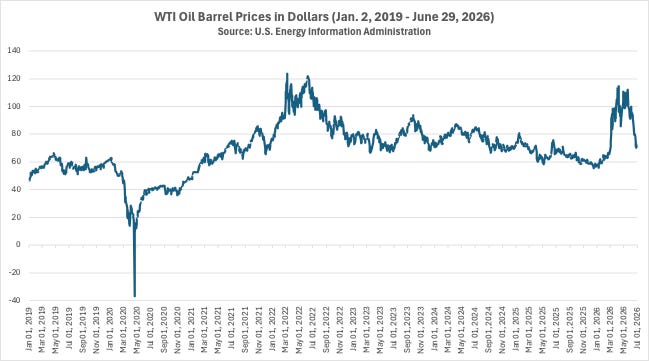
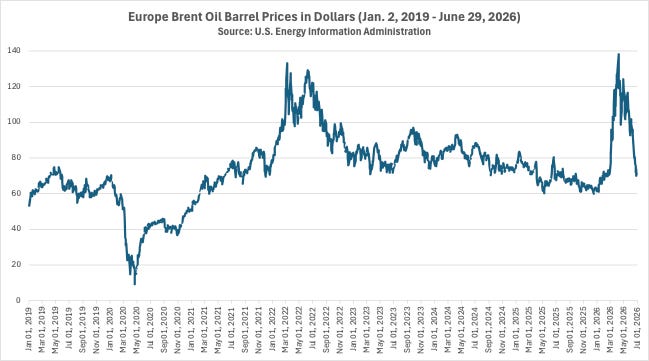
However, what the numbers do not reveal are the causes and context that led to and framed the two price shocks. Nor do they explain why the supposed, though unestablished, mishandling of the global energy markets by one administration excuses the entirely foreseeable crisis created without any preparation by the current government.
The potential for Iran to use the Strait of Hormuz to cut off global petroleum supplies was not a surprise. As far back as the 2002 Millenium Challenge war games, the U.S. military was aware of the potential for a successful closure of the Persian Gulf using asymmetric warfare.3 If Trump, his War Secretary Pete Hegseth, and the rest of the administration did not know, then they simply were not listening. That there was seemingly no preparation in anticipation, reveals the utter incompetency of the administration.
The loss of nearly one billion barrels of oil to date is a global energy catastrophe, and one of Trump’s own making.4 However, oil prices, like any commodity with a futures exchange, are not solely determined by material supply and demand metrics. Perception influences prices and a multitude of factors are working against calming market forces: the destabilization of the region, the need for an influx of capital to repair the widespread devastation incentivizing oil producing nations to keep prices high, the lack of resolution to underlying tensions, and the absence of any workable strategy by the U.S. to prevent a future closure of the Strait.
Furthermore, this war seems to have revealed to the Iranians that perception is their greatest weapon, as actually closing the Strait of Hormuz has turned out to be less important than the threat or risk of doing so. If Iran can make the risk sufficiently high that tanker owners are unwilling to risk their ships traversing Hormuz or insurance prices are too hefty to provide a sufficient profit, then the Straits are functionally closed for business. After all, no number of demining operations or military escorts can guarantee safe passage from land-based missiles or drone attacks. So, Trump is not only solely responsible for the current oil shock, but he has also confirmed for the Iranians just how strong their strategic position is as a deterrent.
But what about the 2022 spike? Does it at least show Biden was an equally ineffective manager of global energy supplies?
No. Just because Trump caused this current crisis, it does not follow that presidents actually control global energy prices. Policies can certainly impact prices, but this connection must be demonstrated.
For the 2022 spike, most of the causes are fairly evident. First, as the earlier graphs revealed, prices had been rising significantly since an all-time low in 2020 as the world came out of the COVID-era lockdowns. A massive spike in demand paired with restrained production meant oil markets experienced a significant price shock.5
In such a situation, which is largely influenced by external players such as OPEC or private firms, there are limited tools available for any presidential administration. One notable tool is the Strategic Petroleum Reserve (SPR), created in response to the oil crisis of the early 1970s, which Biden tapped into releasing a historic 180 million barrels starting in March of 2022.6
However, the 2022 supply shortage was not just a consequence of “natural” market forces. Major global events had a significant impact on oil supply, most notably, Putin’s invasion of Ukraine in February of that year.
Russia’s attack triggered an immediate response from the U.S. and EU. In addition to condemning the aggression the U.S. and EU engaged in a joint effort to exert pressure to end the conflict in Eastern Europe short of a direct confrontation between Russia and NATO. This included expanding sanctions on Russia (some of which the Trump administration had previously initiated against subsidiaries of major Russian energy conglomerates).7
The added sanctions in 2022 essentially severed Russian energy exports from Western markets who were their main consumers and for which the transportation infrastructure already existed. However, Russia simply turned eastward and found new consumers in China and India. To adjust for the increased transportation costs, they had to decrease their prices to remain competitive cutting into their revenues.8
Thus, while sanctions were necessary for anyone not willing to simply cede Ukraine to Russian expansionism, the impact of Biden and the EU’s policy decisions on global energy production or prices was minimal.
However, there was another contributing factor that has seemingly been ignored or forgotten in the current discourse. Why did other major energy players, most notably Saudi Arabia, not even attempt to make up for the overall energy shortages as demand rose in 2022? Was it simply uncertainty about a market at the whim of new COVID variants or was it an attempt to make up for the losses of the past two years?
Not entirely. Actually, it was partially due to the “master dealmaking” of the first Trump administration
As noted earlier, in 2020, oil prices plummeted. In fact, it was such a dramatic crash that WTI went negative for the first time in history being recorded at -$36.98 on April 20, 2020.9 Negative commodity pricing occurs when the cost of transport and storage exceed potential returns requiring producers to incentivize offloading their product to a market with little to no demand.10
Of course, much of this collapse in demand was due to the 2020 pandemic and the associated global lockdowns. However, the initial drop in prices also triggered a feud between two major energy suppliers feeling the economic stress of the loss of their major export commodity. In early March, Russia undermined OPEC’s proposed production cut leading to a retaliation by Saudi Arabia and ultimately leading to an oil price war between the two energy exporters.11
By dropping fuel prices to such artificial lows at a time with such little demand, oil producing firms faced a nearly existential financial risk. This precipitated a nearly universal demand for a swift resolution to the Russia-Saudi oil conflict.
Enter Donald Trump at the end of his first administration and facing an election amidst a once-in-a-century global pandemic that was already jeopardizing the global economy. Seeking to avert a collapse of America’s energy sector, Trump brokered an agreement between Russia and Saudi Arabia slashing crude oil production dramatically and setting a schedule that would slowly allow its return to normal over an extended period.
That timeframe… 2 years.
The cuts decreased productivity initially by 9.7 million barrels per day, about 10% of global supply compared to the year prior. This cut was fine during the height of COVID which saw a nearly 35% reduction in demand.12 However, by April of 2022 (two months after the start of Russia’s invasion of Ukraine), the end of Trump’s negotiated deal still had production cut by approximately 6 million barrels per day, despite a resurgence of demand and the sanctioning of Russian oil exports.13
Thus, amidst a reopening global economy and the conflict in Ukraine, Saudi Arabia and the rest of OPEC was bound by Trump’s agreement and prohibited from increasing production to make up for the global supply insufficiencies. Despite slightly increasing production levels in the summer of 2022, which incidentally followed shortfalls in supply quotas due to structural issues caused by the pandemic,14 OPEC+ (which now included Russia) reached an agreement in October 2022 to continue production limitations.15
Presidents do not control oil prices but they can shape events that impact them even years after their time in office. Trump’s 2020 deal set up the 2022 spike by artificially capping production based on his inaccurate prediction of where global energy demand would be two years after the start of the pandemic. We can only imagine how devastating things would have been if Trump had been right in underselling the pandemic and demand had risen a year or more before the end of his brokered arrangement. This deal would also set up the framework for the next OPEC+ agreement that continued the limited production at a time of resurgent demand.
At the start of 1979, the already month-long oil strikes of the Iranian Revolution led to a loss of 4.8 million barrels of oil per day, a deficit of approximately 7% of global production.16 In February of that year, the first ever Secretary of Energy, James R. Schlesinger, authored a memorandum to President Jimmy Carter detailing a plan to manage even a long-term loss of essentially all of Iran’s oil production – largely based on an increase in Saudi extraction which had already grown by nearly 3.5 million barrels per day. However, the Secretary concluded his memo with a warning regarding the risk of a public panic artificially impacting the market and causing a pricing crisis.17
Despite the increased production by Saudi Arabia and the other measures taken by Schlesinger and the Carter administration, prices would still more than double from around $13 to $34 a barrel and would remain high until the mid-1980s.18 There was not much the Carter administration could do to overcome the “Crisis of Confidence.”19 The simple perception of a second oil crisis in a decade ended the Carter administration with the 1980 election of Ronald Reagan.
It has long been a fixture of U.S. presidential politics to use gas prices as a yardstick for measuring an administration’s success. When prices spike the traditional answer is to deflect blame while claiming that president’s do not set fuel prices.
However, policy decisions matter. The contrast between 2022 and 2026 offers a clear example of these two dynamics. In Trump’s case, his policy decisions are a direct cause. If you want to increase the cost of oil, starting wars in the Middle East is an easy way to do it. The Bush administration’s 2003 invasion of Iraq would not only double (or more) historic averages, but make that increase from $20-$40 a barrel to $60-$100 a normal fact of life.20
Whatever rationalizations one may have for Trump’s actions in Iran (especially given the lack of any serious gains from the conflict), the war was a choice. A choice that did not have to be made and with easily foreseeable consequences for which Trump failed to account. The blame for the current surge in prices, an increase that will likely last through at least year-end, falls squarely on Trump’s shoulders.
Conversely, the Biden administration was stuck facing global events they did not create but had to manage. All the while, they were limited by a decision made by the first Trump administration to suppress global production that continued through the reopening of the global economy.
Trump, like Biden, may not be to blame for all of the events of 2022, but it turns out that Trump did play a significant role in that oil crisis as well, a stunning lack of foresight for the supposed “Dealmaker-in-Chief.”
Daniel Dale, “Fact Check: Trump Posts Wildly Deceptive Chart on Oil Prices,” CNN, May 8, 2026, https://www.cnn.com/2026/05/08/politics/trump-oil-prices-chart-fact-check.
U.S. Energy Information Administration, “Cushing, OK WTI Spot Price FOB,” Petroleum & Other Liquids, U.S. EIA, Date Accessed: July 6, 2026, https://www.eia.gov/dnav/pet/hist/RWTCD.htm.; U.S. Energy Information Administration, “Europe Brent Sport Price FOB,” Petroleum & Other Liquids, U.S. EIA, Date Accessed: July 6, 2026, https://www.eia.gov/dnav/pet/hist/RBRTED.htm.
Lt. Gen. Paul K Van Riper, “Opposition Force Senior Mentor’s Observations of Millenium Challenge 2002,” National Security Archive, August 12, 2002, https://nsarchive.gwu.edu/document/32484-lt-gen-paul-k-van-riper-senior-mentor-opposition-force-millennium-challenge-2002.; Nate Jones, “How the U.S. Military Lost a $250 Million War Game in Minutes,” The Washington Post, October 30, 2004, https://www.washingtonpost.com/investigations/2024/10/30/usa-war-military-money-report/.
International Energy Agency, “Oil Market Report,” IEA (May 13, 2026): 5, https://www.iea.org/reports/oil-market-report-may-2026.
U.S. Energy Information Administration, “Crude Oil Prices Increased in 2021 as Global Crude Oil Demand Outpaced Supply,” January 4, 2022, https://www.eia.gov/todayinenergy/detail.php?id=50738.
Benjamin Harris and Catherine Wolfram, “The Price Impact of the Strategic Petroleum Reserve Release,” U.S. Department of the Treasury, July 26, 2022, https://home.treasury.gov/news/press-releases/jy0887.; U.S. Department of Energy, “DOE Announces Final Contract Awards From President Biden’s Emergency Release From the Strategic Petroleum Reserve,” November 3, 2022, https://www.energy.gov/articles/doe-announces-final-contract-awards-president-bidens-emergency-release-strategic-petroleum.
BBC News, “Nord Stream 2: Trump Approves Sanctions on Russian Gas Pipeline,” December 21, 2019, https://www.bbc.com/news/world-europe-50875935.; Lara Jakes, “U.S. Imposes Sanctions on Russian Oil Company Supporting Venezuela’s Leader,” The New York Times, February 18, 2020, https://www.nytimes.com/2020/02/18/world/americas/venezuela-russia-sanctions-trump.html.
Lutz Kilian, David Rapson, and Burkhard Schipper, “The Impact of the 2022 Oil Embargo and Price Cap on Russian Oil Prices,” Federal Reserve Bank of Dallas (March 2024): 44-47, https://www.dallasfed.org/~/media/documents/research/papers/2024/wp2401.pdf.; Centre for Research on Energy and Clean Air, “Tracking the Impacts of G7 & EU’s Sanctions on Russian Oil,” Date Accessed: May 30, 2026, https://energyandcleanair.org/russia-sanction-tracker/.
U.S. Energy Information Administration, “Cushing, OK WTI Spot Price FOB,” Petroleum & Other Liquids, U.S. EIA, Date Accessed: May 30, 2026, https://www.eia.gov/dnav/pet/hist/RWTCD.htm.
Andrew Walker, “US Oil Prices Turn Negative as Demand Dries Up,” BBC News, April 20, 2020, https://www.bbc.com/news/business-52350082.
Richie Ruchuan Ma, Tao Xiong, and Yukun Bao, “The Russia-Saudi Arabia Oil Price War During the COVID-19 Pandemic,” Energy Economics 102 (2021): 1-2, https://pmc.ncbi.nlm.nih.gov/articles/PMC8652835/pdf/main.pdf.
Clifford Krauss, “Oil Nations, Prodded by Trump, Reach Deal to Slash Production,” The New York Times, November 12, 2020, https://www.nytimes.com/2020/04/12/business/energy-environment/opec-russia-saudi-arabia-oil-coronavirus.html.
BBC News, “US Backs OPEC Deal with Cuts to Boost Oil Price,” April 12, 2020, https://www.bbc.com/news/business-52226236.
Kaushik Deb and Abhiram Rajendran, “Q&A | Implications of the OPEC+ Announcement to Increase Oil Production,” Center on Global Energy Policy at Columbia SIPA, June 8, 2022, https://www.energypolicy.columbia.edu/publications/qa-implications-opec-announcement-increase-oil-production/.
Ahmad Ghaddar, Alex Lawler, and Rowena Edwards, “OPEC+ Agrees Deep Oil Production Cuts, Biden Calls it Shortsighted, Reuters, October, 5, 2022, https://www.reuters.com/business/energy/opec-heads-deep-supply-cuts-clash-with-us-2022-10-04/.
James D. Hamilton, “Historical Oil Shocks,” Prepared for the Handbook of Major Events in Economic History, (February 1, 2011): 16, https://econweb.ucsd.edu/~jhamilton/oil_history.pdf.
U.S. Secretary of Energy James R. Schlesinger, “Memorandum From Secretary of Energy Schlesinger to President Carter,” Office of the Historian, January 4, 1979, https://history.state.gov/historicaldocuments/frus1969-76v37/d181.
Daniel Yergin, The Prize: The Epic Quest for Oil, Money & Power (Simon & Schuster, 1991), 784.
CBS News, “From the Archives: Jimmy Carter’s ‘Malaise’ Speech – ‘A Crisis of Confidence,’” YouTube Video, Date Accessed: May 30, 2026.
U.S. Energy Information Administration, “Cushing, OK WTI Spot Price FOB,” Petroleum & Other Liquids, U.S. EIA, Date Accessed: May 30, 2026, https://www.eia.gov/dnav/pet/hist/RWTCD.htm.; U.S. Energy Information Administration, “Europe Brent Sport Price FOB,” Petroleum & Other Liquids, U.S. EIA, Date Accessed: May 30, 2026, https://www.eia.gov/dnav/pet/hist/RBRTED.htm.